
Healthcare improvement projects from idea to sustained results
Structured project management supporting A3, PDSA, root cause analysis, kaizen events, and other improvement methodologies — tracking from problem identification through intervention to sustained results.

Improvement projects stall because teams lack structure, leadership loses visibility, and learnings stay trapped in one department. Most project management tools are built for software teams, not healthcare improvement.
How it works
- 1
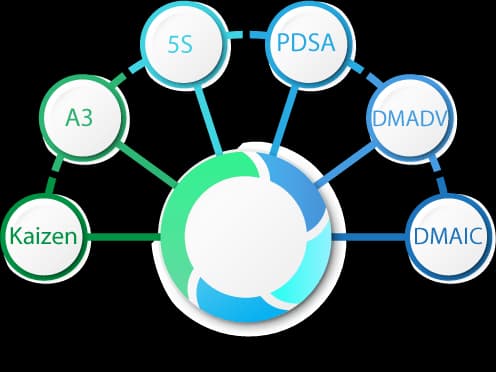
Support for multiple improvement methodologies — A3 problem solving, PDSA cycles, root cause analysis, kaizen events, DMAIC, and more
- 2
Track projects from problem identification through analysis, countermeasures, and sustained metrics
- 3
Built-in analysis tools — 5 Whys, fishbone diagrams, FMEA, process mapping, and other frameworks
- 4
Share and scale successful improvements across departments and sites
- 5
Connected to safety events and metrics — projects emerge from real data, not just management mandates
What makes ImprovementFlow different
Most project management tools support one methodology. ImprovementFlow supports the full toolkit — A3s, PDSA cycles, root cause analyses, kaizen events — with built-in analysis tools like fishbone diagrams, 5 Whys, and FMEA. Projects connect directly to the safety events and metrics that surfaced the problem, creating a traceable thread from frontline observation to organizational improvement.
At UNC Health Care: 95+ completed improvement projects with ~70% sustained success rate based on traced metrics.
Read the UNC Health Case StudyImprovement methodologies we support
A3 problem solving for healthcare teams
Replace scattered A3 documents with a structured digital workflow. Track problems, countermeasures, and outcomes in one place.
PDSA cycles for healthcare improvement
Track rapid PDSA improvement cycles with connected metrics. Stop losing iterations to paper forms and disconnected spreadsheets.
Root cause analysis in healthcare
Connect RCA findings to improvement projects and track whether corrective actions actually stick. Stop losing RCA action items.
Learning from defects in healthcare
Proactively analyze process failures before they cause patient harm. Build the infrastructure to capture near-misses that feed LFD analysis.
Running kaizen events in healthcare
Sustain kaizen event gains with metric tracking and huddle board integration. Stop letting improvement gains fade after the event.
Lean methodology for healthcare organizations
Lean principles adapted for clinical settings — without requiring lean certification. Built with lean coaches from UNC Health Care.
Gemba walks and leadership rounding in healthcare
Connect gemba observations to safety events and improvement projects. Turn leadership rounding into actionable intelligence.
Standard work for healthcare processes
Connect standard work compliance to safety events. Know when processes aren't being followed before a near-miss becomes an adverse event.
Value stream mapping for healthcare
Connect VSM findings to improvement projects that stick. Stop losing value stream improvements to disconnected follow-up.
Building a high reliability organization in healthcare
HRO principles require infrastructure, not just culture. See how safety reporting and process reliability analysis support HRO.
Just Culture in healthcare safety
Non-punitive reporting requires Just Culture infrastructure. Support anonymous reporting and closed-loop feedback that builds trust.
DMAIC and Six Sigma in healthcare
Healthcare Six Sigma projects stall at Measure. ImprovementFlow provides the metrics infrastructure that data-driven improvement requires.
Analysis tools & frameworks
5 Whys root cause analysis for healthcare
Learn when 5 Whys works — and when it doesn't — for healthcare RCA. ImprovementFlow structures iterative questioning within improvement projects.
Fishbone diagrams for healthcare quality improvement
Use Ishikawa diagrams to map contributing factors for complex safety events. ImprovementFlow supports collaborative fishbone analysis within RCA projects.
FMEA for healthcare risk analysis
Use FMEA to identify failure modes before harm occurs. ImprovementFlow tracks FMEA findings and whether risk mitigations are implemented.
Bow-tie analysis for patient safety
Map threats, barriers, and consequences with bow-tie analysis. ImprovementFlow reveals which safety barriers are failing using real event data.
Pareto analysis for healthcare quality data
Apply the 80/20 rule to patient safety data. ImprovementFlow's reporting enables real-time Pareto analysis without manual data assembly.
Process mapping and swim lane diagrams for healthcare
Map clinical and operational workflows with swim lane diagrams. ImprovementFlow connects process maps to safety events at specific process steps.
Human factors analysis in healthcare safety
Apply the HFACS framework to understand systemic factors behind human error. ImprovementFlow captures contributing factors beyond the immediate actor.
Fault tree analysis for patient safety
Use top-down deductive analysis to map complex failure pathways. ImprovementFlow provides the event data needed to build accurate fault trees.
Safety barrier analysis and defense in depth
Identify which safety defenses are failing with barrier analysis. ImprovementFlow's event data reveals which barriers are degrading over time.
Change analysis for root cause investigation
Systematically compare what changed before a patient safety event. ImprovementFlow's trending reveals temporal correlations with organizational changes.
Related Solutions
Currently viewing: Improvement Projects
See it in action
Start a targeted pilot in 1–2 weeks, then expand into a customized multi-site program in less than a month. We will walk through the workflow that matters to your team before you decide.